
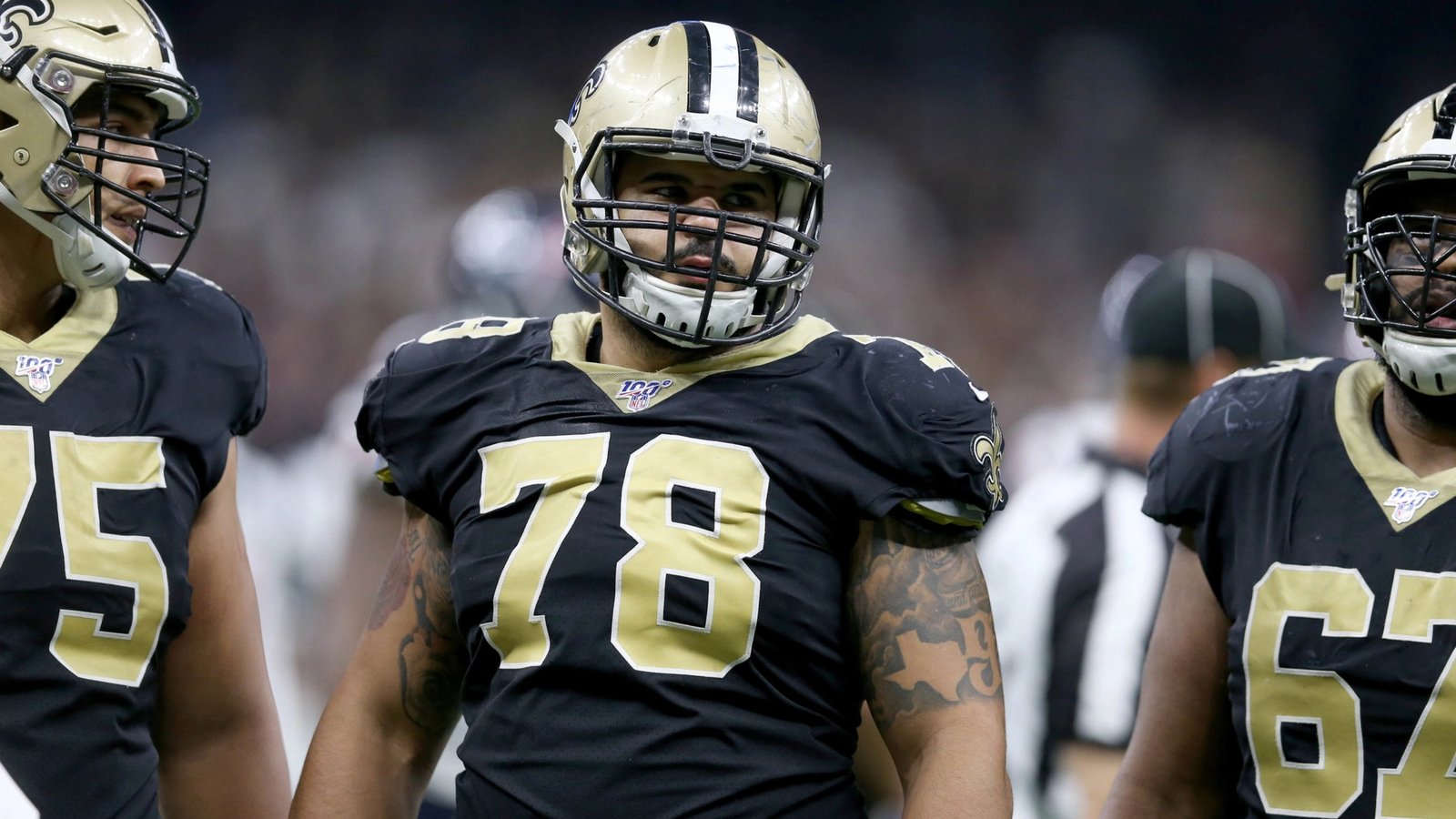

The Saints want players who can move.
Not just at the skill positions, but also on the offensive line. Blocking and being assignment sound are still the chief responsibilities for Drew Brees' group of protectors. That will never change, but New Orleans now appears to be placing a premium on linemen with athletic ability and has assembled one of the NFL's fastest offensive lines.
That isn't a mistake.***premium***
The Saints' projected starters on the offensive line have a collective average 40 time of 4.954 seconds, placing it second behind the Philadelphia Eagles, whose five starters clock in at 4.950 seconds. Every other team is over five seconds. The Ravens (5.43 seconds) are the slowest group in the league. This is, of course, assuming rookie Cesar Ruiz replaces Larry Warford on the line, which Sean Payton said he would like to have happen after the first round of the draft.
When you look at things through the prism of getting burners on the line, all of the Saints roster moves make sense, and some upcoming ones might now be foretold.
Here's the battle Warford is fighting. When he's in top shape and training to run, he only possesses 5.58 speed, which makes him one of the slowest offensive linemen in the NFL. In shape or out of shape, he's not going to win a race. Granted, 40 times for offensive linemen might not be the greatest measure of measuring short-area speed for an offensive lineman, but Warford's 10-yard split of 1.85 seconds is also slow. The other guys on the interior line -- Ruiz (1.77), Erik McCoy (1.72) and Andrus Peat (1.81) -- are all faster.
Now, Ruiz isn't exactly fleet of foot, but he moves well for someone his size, and it is easy to see how he would be an upgrade if the team is looking for athletes on the line.
The first-round pick's 40 time of 5.08 seconds was the third-fastest since 2000 among centers who weigh more than 305 pounds. His speed would rank 10th among right guards. If Ruiz replaces McCoy at center, he'd be the NFL's seventh-fastest player at that position. McCoy, meanwhile, would be the NFL's fastest right guard or center (4.89).
The accumulation of athletic big men doesn't end there. Terron Armstead (4.71) would be the fastest left tackle in the NFL if he still possessed his rookie speed. Injuries have slowed him down a little, but he is certainly still among the top-10 players at that position. While Ryan Ramczyk never ran an official 40, his coaches at Wisconsin told former Saints beat writer Joel Erickson that the right tackle ran a 4.91 while in college, a time that would place him seventh overall at his position. Even if that number is a slight exaggeration, Ramczyk still isn't slow and the rest of the line is moving well enough to make up for it.
Andrus Peat is the only player who isn't burning up the turf. The left guard ran a 5.18 40, which isn't bad for a 6-foot-7 player. The time ranks 16th among starters at the position. On Sundays, when healthy, Peat can get moving and does a lot of good things in the second level, but his time, which is average for the position, is the weakest link.
So, why the need for speed?
Generally speaking, teams that like to run zone-blocking schemes will benefit most from having athletic players who can move laterally. Zone teams aren't trying to bully their opponents. These teams try to win through footwork and precise movements. Having a bunch of players who can move creates a significant advantage on these runs, and, of course, on screens, which New Orleans likes to use.
The Saints (222 attempts) and Eagles (266) both used zone looks as the primary weapon in the running game last season. This approach is not likely to change, and New Orleans has room for improvement after only averaging 4.04 yards per carry on these plays. The average was as high as 4.48 yards per carry in 2017.
As for screens, the Saints averaged 7.3 yards per attempt in 2017, 5.8 yards per attempt in 2018, and 5.3 yards per attempt last season, which is quite average for an offense that prides itself on being an excellent screen team.
Some of the fall-off in both areas can get attributed to Alvin Kamara battling injuries, but Warford blew 13 blocks in the running game last season. His blown block percentage of 3.7 percent was the 15th worst mark among offensive linemen. Ruiz, when you watch him, doesn't tend to make those mistakes.
Having athletic players can help teams that like to pull, especially on the backside, so this could be a possible change. The Saints attempted 65 runs with any puller last season and gained 319 yards (4.91 yards per carry). Considering the success and (potentially) having faster players on the field next season, New Orleans will probably look to use these runs more often.
Interestingly, though, speed doesn't seem to be a requirement for successful pulls. The Ravens, despite their lack of fast players on the offensive line, pull almost as often as any team. Mark Ingram had 80 carries on backside pulls last year, which are running plays when the guard from the other side of the formation comes from behind and lays down a block on a linebacker.
Often, this approach gets used as part of power or counter runs, but it has become more prevalent in zone schemes. So, the options could open in many ways by adding Ruiz and potentially moving McCoy to guard.
One thing is for sure, a new day on the offensive line came fast. McCoy and Ruiz represent not only a change in personnel but perhaps a change in philosophy. Everyone who is behind needs to try and keep up.
Saints news as it breaks.
The whole point of following a team is knowing what's happening. Set it up once and stop missing things.
Enable notifications →
Sign in to join the conversation
Sign In