
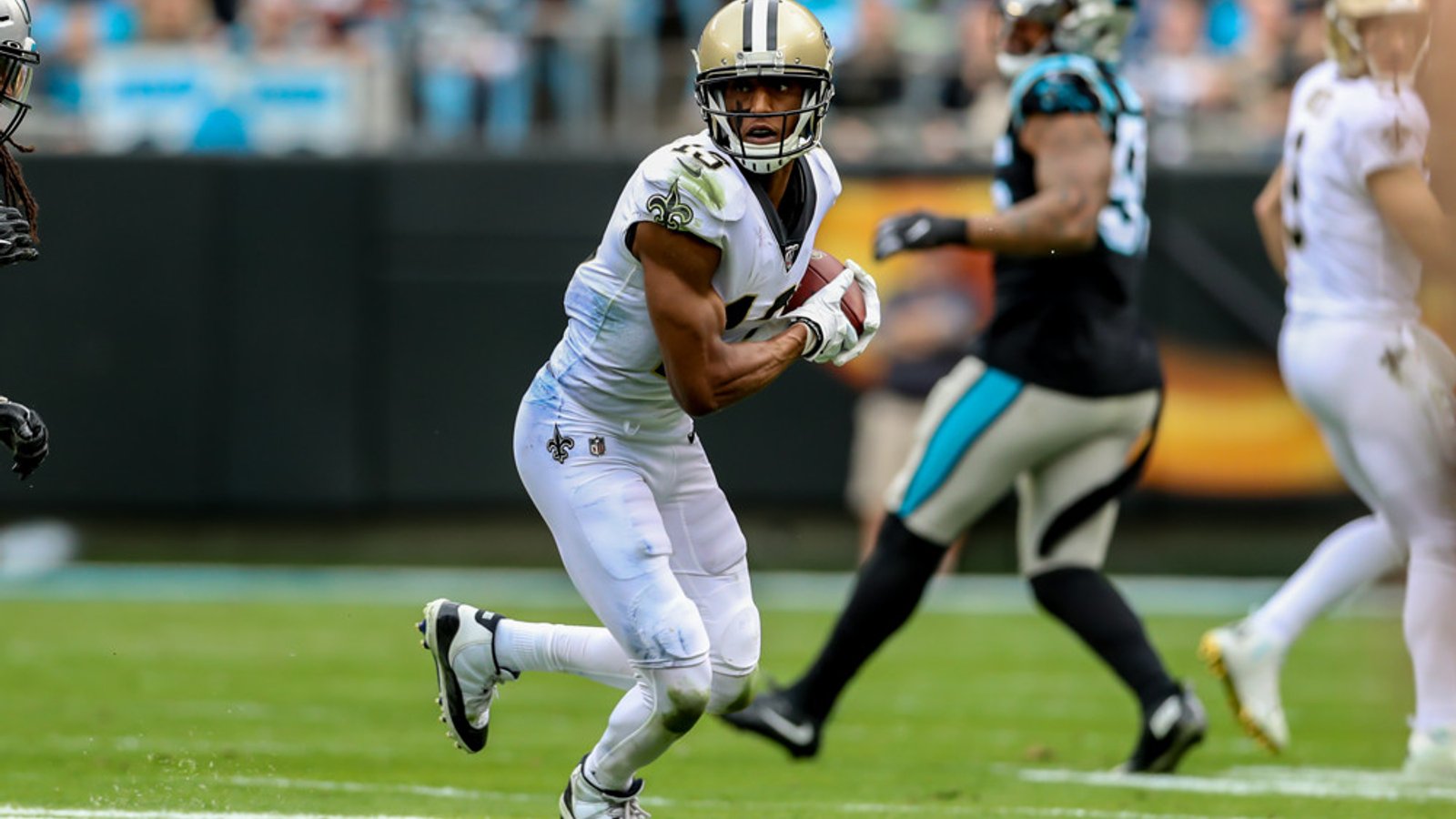

Michael Thomas isn't fast enough.
He's not a burner.
He can't win deep.
He might not create enough separation with his route running.
The knocks made against the Saints wide receiver entering the league look idiotic in hindsight. People raced to draw conclusions based on his 4.57 40-yard dash time, and even though he has compiled the greatest four-year credentials of all time for a wide receiver, Thomas still falls victim to lazy analysis. But if you watch him play and study his process, you already know he plays faster than his 40 time.
Quantifying this observation isn't easy because anecdotal evidence is faulty. You can look at Thomas' fourth-quarter reception against the Tennessee Titans, the one where he puts Logan Ryan on his backside while cutting toward the middle of the field on a crossing route, and know he runs his routes a little bit differently than anyone else.
Was this play an outlier or one of many examples of Thomas punishing defensive backs? I decided to find out – or at least make an attempt toward quantifying this observation.
To accomplish this goal, I reviewed all 185 passes thrown to Thomas last year and measured the peak level of separation he created on each play. Other stats will tell you how open a player is at the time of throw or catch. This is a little bit different. I went through and measured the highest level of separation Thomas achieved on each target, which can occur at various points before or between the throw and catch.
Here is what I figured out:
***premium***
Breaking out
One of the most devastating routes Thomas ran last season came during a Week 5 game against the Tampa Bay Buccaneers. The All-Pro receiver lined up against Vernon Hargreaves, went about six yards down the field before planting his foot and cutting to the outside. The move was so fast and sudden that Hargreaves extended about five yards up the field before he gathered himself and turned the right direction.
This was maybe the easiest touchdown throw Teddy Bridgewater made all season.
Thomas receives a lot of recognition for how automatic he has been throughout his career on slants and curls, and, quite honestly, it would be difficult to make a case that anyone in the world is better on those two routes.
But for this exercise, the wide receiver was most impressive on outs. Thomas' ability to sharply change direction often made the person attempting to stick with him look foolish, which is likely one of many reasons opposing cornerbacks only lined up within 3.5 yards of Thomas on 67 of his targets this season.
Thomas was targeted on 10 out routes this season where the cornerback started within 3.5 yards of Thomas (we used this distance as the cutoff to try to isolate plays where the defense was at least doing something close to pressing Thomas). He created an average of 3.4 yards of separation on those plays.
In route
Thomas was targeted six times on in routes when the cornerback started within 3.5 yards of the line of scrimmage.
The results were about the same as the out route. Thomas averaged 2.57 yards of separation on these plays. Jacksonville's A.J. Bouye was the biggest victim. Thomas beat his jam to get off of the line of scrimmage, ran free by about 3.5 yards, and then pulled in a 7-yard reception.
Another highlight came against Atlanta's Desmond Trufant. The Atlanta cornerback had Thomas blanketed going down the field, but the wide receiver managed to create nearly three yards of separation as he broke to the inside of the field.
Overall, Thomas caught 10 of 14 targets on in routes for 112 yards against man coverage. The usage is comparable to what he posted in 2018, when he caught 11 in routes for 166 yards.
Crossing route
The crossing route typically isn't a huge separation play. This is something the Saints often use to beat up teams for playing zones of off coverages.
But here's where things get interesting.
After only targeting Thomas on a crossing route twice against tight man coverage (3.5 yards or fewer) during the first 10 weeks of the season, Drew Brees targeted him on it during each of the last five games of the season. And except for one miss against Carolina during the finale (James Bradberry played Thomas very well), the route worked every other time.
Perhaps this is something the Saints will do more of moving forward, considering it had success late in the year. Or this might have just been a way to break a trend that had developed. If nothing else, by showing the route against this type of coverage, Thomas was reminding cornerbacks they need to be ready for him to break inside in the shorter areas of the field. No more cheating.
Slants
When starting this study, the idea was to only look at routes with deliberate breaks, something where Thomas plants his feet and changes direction.
You wouldn't expect slants to be a big separation route. When you close your eyes and picture Thomas catching a slant, it's probably one that includes him making a play with a defensive player on his back.
Often, this image is true.
But here's the problem with anecdotal evidence: Sometimes it paints a false picture. Thomas actually has a knack for creating a good amount of separation on slant routes by either beating jams or getting players to bite on his jab step. With defenders within 3.5 yards of the line of scrimmage, Thomas created an average of 2.17 yards of separation on 21 routes.
A handful of these plays especially stand out. On one against the Falcons, Thomas fooled Falcons cornerback Isiah Oliver so badly with a jab step that the defensive back had to spin all the way around to gather himself. Thomas ended up being open by 3.5 yards after having the cornerback right in his face.
Same game. Go to the fourth quarter. Thomas does it again, this time to cornerback Blidi Wreh-Wilson, creating 4.5 yards of separation. At least Oliver wasn't the only one who looked bad during that week's film session.
Brees and Thomas missed on their first slant against tight coverage during a Week 1 game against Houston. The pass was a little too far out, and the wide receiver couldn't reel it in. Thomas responded by catching the next 20 thrown to him against tight coverage. One of those included a catch against Indianapolis when he was open by less than a yard.
There's a reason Thomas is the best receiver in the league. He can do it all, which brings us to the last section of this study.
Can't be covered
Thomas is often open even when it looks like he isn't open.
But how often did the Saints throw him passes when he was legitimately blanketed -- like not open at all -- and couldn't shake free? Not often, but, of course, he still succeeded when those passes arrived.
Thomas was thrown four passes last season (against all coverages) when he was never open by more than a yard. All of those passes came during three games – one against Dallas, one against Atlanta (Week 10), and two against the Colts. Thomas caught three of them, including one back-shoulder throw that gained 20 yards.
What about when you take it out to 1.5 yards? The number jumps up to 37 targets. Thomas caught 22 for 302 yards, including a 49-yard reception against the 49ers.
So, Thomas is usually going to find a way to create a couple of yards of separation. But even when he doesn't, he'll probably still make the play if the ball gets there.
That's just what he does.
Saints news as it breaks.
The whole point of following a team is knowing what's happening. Set it up once and stop missing things.
Enable notifications →
Sign in to join the conversation
Sign In